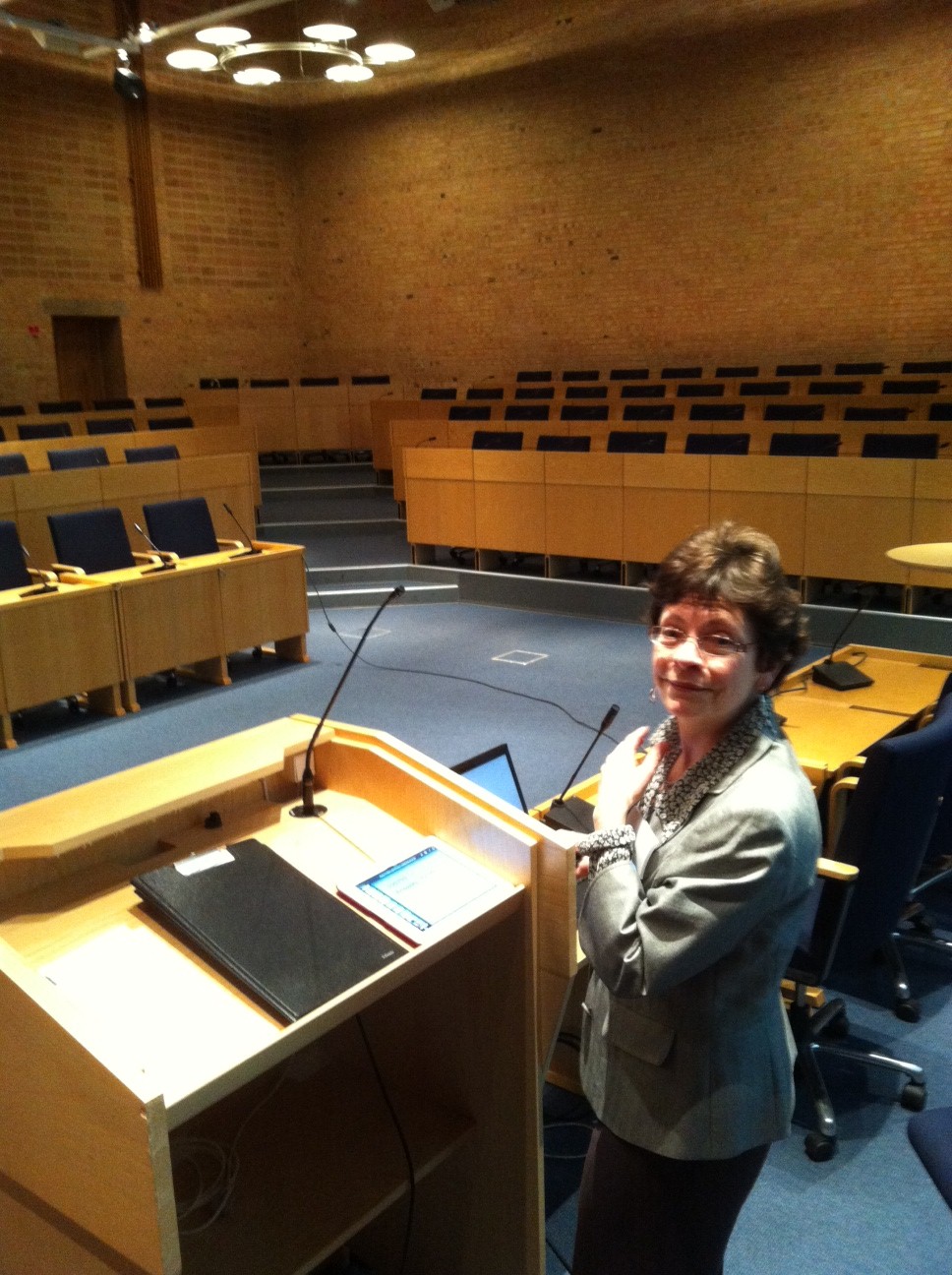
Monday, 30 September 2013

How I (sometimes) work

Challenged as I was by Georgina to answer the questions about how I work - I thought it rude not to do so..........but consider yourself warned - it ain't pretty. There is a plan - if only I could find it.


Location: Cambridge (UK)
Current gig: Faculty Librarian, English Faculty
Current mobile device: iphone 4
Current computer: Probably Dell (Uni has an agreement with them) with  - yes a very nice widescreen flat monitor.
One word that best describes how you work: one word? eek? impossible - I will allow myself two: focused and forgetful

What apps/software/tools can’t you live without? GoodReader, Google calendar, facebook, Google maps (lapsed Geographer), Thunderbird (I love email)

What’s your workspace like? Ah, depends when you look. Currently looks quite pretty with new chairs and a hand-made quilt wall hanging.......
Mostly my desk is roughly akin to the many many layers of sedimentary rocks that you might see in the Grand Canyon. Yes, I've lost the odd thing, but mostly I know where everything is. Once the piles of paper start to topple then I might have a tidy up.

What’s your best time-saving trick? Always go out at lunch break for a brisk walk. Saves making  a huge numbers of errors, and generally I've solved one of any number of problems by the time I get back.

What’s your favorite to-do list manager? Google calendar is brilliant for a project management approach to a task, breaking it down into manageable chunks of stuff that must be done by x or y. When things are serious good old pencil and paper to-do lists.

Besides your phone and computer, what gadget can’t you live without? ipad

What everyday thing are you better at than anyone else? Moving at the speed of light during a 5 minute conversation with staff from one subject to another, to another. We're all exhausted at the end. Also - sending emails with instructions. My logic is - send an email before I forget what I was thinking about. (see last point below)

 What are you currently reading? Trashy novels - can't even recall the current title. Though recently I have avidly read some 'Rough guides...' for Vancouver and Grand Canyon. (told you, I'm a lapsed Geographer.)

What do you listen to while you work? My own voice muttering.

Are you more of an introvert or an extrovert? Introvert definitely. Love my own office, can come out to play when I choose.

What’s your sleep routine like? Well for someone who has 'done' kids the one thing I'm brilliant at is getting up early in the morning.

Fill in the blank: I too would love to see Heather Lane answer these same questions.

What’s the best advice you’ve ever received? Keep asking questions

Is there anything else you’d like to add? To deal with the two words up above: Focused - When stuck into working at something I don't need to switch off email etc etc to concentrate; I just don't notice anything else. Forgetful - it could be an age thing, or just there's too much in my head to keep it contained and I just cut swathes of conversations and information clean out of my head - hence the prolific emailing.

Well - I told you it wasn't pretty.


On how car rental experiences made me think........

Airport rental cars and libraries - anything in common? Well, they're a service, they have 'customers' who need a resource. What's not in common? I suppose the rental resource is very identifiable; a car is....a car...is a car - right? Libraries – well they’re just more complex but still a service.

An odd comparison you might think, but my very recent user experience of the one made me wonder about the other.


A centralised rental car system (such as in Phoenix) works as follows: As the consumer, I still have choice about who I book with. But I have no choice about where I physically go to deal with the booking on arrival; there is only one bus stop to find at the airport, one type of bus to look for to travel in and one place to pick the car up. With all rental car services under one roof, all the car servicing, checking, 'keys handing over' is dealt with completely separately to the booking-in system. One building means economies of scale, and so I have access to food, bathrooms, and lots of frequent buses getting me to and from the airport.

What's not to like? I suppose there was that slight frisson of worry when the bus set out on what appeared to be a 3 hour long journey to the rental centre from Phoenix airport, with no information given out about how long it would take to get there. 'We must remember to allow plenty of time when we come back', we muttered to ourselves.

For a customer, car rental services have certainly done their homework and worked out exactly what it is that people want. Customers clearly still want choice, they want a person looking after their needs on the other side of the 'Alamo' (in my case) desk, and someone to hold their hand as maps are explained in order to negotiate the hellish road system about to be confronted. But the process of getting to the centre, documentation vetted, through to picking up the car (two upgrades, and a free bottle of water to cope with 35 degree temps merely 10 mins later), and then the utter relief of how easy it was to return said car and get back to the airport in plenty of time for the return flight was brilliant.

So why think of libraries? The car rental service was centralised and the process was beautifully efficient and effective. I assume it's cheaper to run it this way. But in our second airport they were in the middle of changing over from one system to another and I accosted the poor (yes, Alamo) lady at the service desk and asked her what the change to a new centralised system was like from her perspective. She was very kind and, though slightly shocked, gave me two answers that I thought rang all too true for the current library centralisation scheme I find myself in the middle of.

  Firstly, she didn't like change. Not rocket science at all, but it makes the clear point that many of us do not like change, especially change that we cannot understand especially well and, by definition, that change management is absolutely crucial to win over good people to a new system.  Just because one person thinks centralised is good certainly doesn’t mean that the next one will.

  Secondly she worried about the lack of control over the bus drivers: they would not belong to the company, Alamo, any more, but just be generic drivers employed to run buses for ALL the rental car services. Would they be loyal? Would the service desk people know the drivers' names? How easily could they deal with problems?  Would the service the bus drivers offered match their current standards. Wow! Familiar or what?! What good would a generic library assistant be at my issue desk wondering where the heck we had stashed the ... extra barcodes; the sellotape, the reservation keys, a spare pencil etc. I’ve experienced this – and it was BAD!

She finished by saying 'But I'm sure it will all be ok'!! Well, day 1 of the new system we returned our car and I think there were some niggling problems they were facing ( eg the new buses were all much longer than the previous ones and causing traffic jams!). Funny how often the devil is in the detail. But, on the other hand what a relief for us to catch a bus that runs every 5 minutes to the airport, rather than waiting (as we did on arrival) all tired and worn out, for 20 minutes before an Alamo bus came our way.

So - I was left with a few questions - what is perfection for our customer? What does that look like? Have we 'got it' yet? Can we combine the premium offering of REAL choice, along with useful centralisation in our libraries? Is it possible for Cambridge, that extreme bastion of choice and 'boutiqueness', to get something right and combine the quality and engagement that personalised service choice offers with a few choice centralised polices and processes that actually make a difference, or will they muck it up? Only time will tell.

Sunday, 21 July 2013

Marketing Schmarketing?

So why go on a marketing course where you find that plenty of the content is familiar and you end up providing plenty of the right responses (at the right time)? This is, of course, an exaggeration, but not far off.  However before you think of me as unpleasantly arrogant, let me explain that the reason I went on this course was to learn, and learn I did. I find that it can be tempting to look around at training that is offered, from all sorts of quarters, and quickly dismiss something with a 'done that' attitude, not always considering what opportunities are missed and what the message this gives to those around us. Perhaps this IS slightly arrogant of us.

So why did I go to this course? Partly because I think there might be something to be gained by not just going to library-focused training, and mostly because I want to keep on learning, and I am willing to try other avenues. Although the course was on marketing, which I have considered previously in my Librarian role, and which my colleague, and co-editor, Andy Priestner, has written about, it looked to offer a different perspective (Business) and none of the other participants were librarians!  In fact I consciously made a point of selecting it from a series of modules that are part of a course I am dipping into at Loughborough Business School.

What did I learn and come away with? Lots of snippets, some theory that I hadn't come across before, brilliant interaction and conversation with people working in such a variety of different jobs, new perspectives and some concrete plans of 'what to do next' in my own context. Oh yes, and an assignment that needs to be written by 11th September!! Ho hum.

Here are a few thoughts that rang true for me. If you are reading the points below you may start saying 'yep I know all that', but of course you might not want to tell me that.................
    · How are we telling our customers what we provide?
    · Who are our influencers and how do we market what we do to them?
    · Don't skimp on the basics - it's so easy to get carried away with the fun of the next service or product that we forget to keep the books tidy on the shelves.
    · Analyse, choose, implement. Make sure the process is applied.
    · Stop trying to do everything for everyone and be targeted - otherwise we run the risk of under-performing.
    · It costs to exit from a strategy. Check the financial implications.
    · Don't always keep on doing new things - check that you are getting as much value from the products and services you already provide. Don't stop innovating but if the user is not bothered with some new thing don't persist to the nth degree!
    · Don't run out of things people want
    · If you find yourself telling a user 'we don't do this', make a note and investigate why you don't.
    · After sales care is vital. When things go wrong for a user - what do we do? And how do we deal with the customer?
    · Building relationships is all about creating a mutually beneficial relationship, but remember that the relationship is on their terms. Just because we wag our tails madly when we see them does not mean that they want to engage. It is important that we respect this. Some might even want to engage with us remotely. Banks do this all the time - it means more ways that we communicate but more ways we engage.
    · Market the 'value' of our services in order to get people to open their wallets.
    · Internal marketing - essential criteria are the ability to persuade, negotiate and recognise and use internal politics. CRUCIAL matrix - Power vs Interest. For LOW interest and HIGH power make sure that they are given a briefing every eg 3 months so that they know what is going on. These people are the change agents and we need to recognise their level of interest. If assume they want to come and see us and are interested in us then we have missed a trick.
    · Use PLAIN words to sell products, don't dress things up with 'fake' terminology.
    · A well-known brand of drink as an example of 'flanking marketing' using segmentation - £10.00 bottle, competitor came along with their version at £9.20. What did they do? Provided a 'special' bottle at £11.00, a regular at £9.90 and a 'value' bottle at £9.00. Tactical strategy which removed competitor fairly swiftly. As a manipulator I like this.
On a practical level some of the things I will be doing soon:


1. buying at least one sofa

2. sending our students a quick one question survey on their preferences for invigilator-manned opening hours

3. preparing a briefing conversation for bosses

4. creating a different system for allocating students to email lists

5. working harder at collaborating with college librarians
 
And one lovely fellow-attendee is going to help me overhaul a workflow process! Yay!


    Sunday, 3 February 2013

    Conference keynote and patchwork

    The thing I love about making anything using patchwork is that each project is unique; the choice of fabrics changes everything, the way it's finished can be yours alone. Of course, you can buy a kit, follow a pattern and use the fabric chosen for you, but so much of the pleasure of the craft is taken away by doing this.

    Having very recently completed the top side of a quilt, and having to invent my own system for finishing it off, I was reminded of the keynote that a colleague, Andy Priestner , and I very recently gave in Denmark at the Winter meeting of the Danish Research Librarians Group. Not perhaps the most obvious of connections from all sorts of points of view!

    Patchwork essentials: you need fabric, an idea of a pattern (perhaps), a means of sewing bits of fabric together
    Keynote essentials: you need a speaker or two, a message, a means of presenting the message

    Keynotes tend towards the same style. Perhaps about an hour, often one presenter, usually based on a poweropint presentation. Given that we had 105 minutes to fill we had to be a bit more inventive, or risk boredom. We had been asked to speak about some of the content in 'the book' so from one perspective we knew our stuff. It takes very little, actually, to get us on our favourite hobby-horse - ie 'boutique' strategies for managing our libraries! How to present it engagingly was more complex and meant that we needed to re-think what a keynote should look like. Activities were introduced, including an excellent quiz that Andy conducted, together with several opportunities for delegates to engage with neighbours when discussing a particular question or issue. We both took turns in speaking, so that the style of talking and presenting varied including using different styles of powerpoint slides. And so on....

    The point being - it was fun re-inventing what a keynote could look and feel like. Just like it's fun (for me!) in creating a piece of patchwork. It all comes down to creativitiy, imagination and the sort of content that inspires you, as presenter or patchworker to want to continue to engage with it yourself.

    It helps that our keynote audience were recpetive and cooperative with our endeavours and that we left Denmark having made a number of helpful connections. Just like it is when I meet another patchwork addict..........

    Tuesday, 1 January 2013

    New Year Delights!


    Sometimes things are just beneath your nose and you never notice them. Other times they are obvious - because they are the perfect solution.

    Here are a selection of resources and links that might just be the perfect solution to the current essay or dissertation or academic interest. Or they might be totally distracting........but worthy for all that!


    1. Gorgeous apps!
    (Oh and if you don't have an iPad, we now have one in the Library where you can try out any of these apps - and more)
    British Library apps for smartphones and tablets:
    • Treasures. This includes the the original version of Alice’s Adventures in Wonderland and medieval books
    • Nineteenth Century books. This includes access to novels of the 18th and 19th Century eg Daniel Defoe's The Life and Adventures of Robinson Crusoe and Fiction and Prose literature eg Frankenstein
    • Royal Manuscripts. This includes illuminated medieval and Renaissance manuscripts from the BL's exhibition.
    • ebook treasures. More information available here. 
    TouchPress with Faber brought out the (now) well-known version of The Waste Land by T.S.Eliot but have recently produced an app for Shakespeare's Sonnets. These productions take the meaning of a 'book' to a new level including a wonderful variety of performances, commentary, notes and images.

    Watch for Faber and Bloomsbury's new online resource for drama and if you want to request a trial contact Libby.

    2. Fascinating news from the University Library.
    Did you notice that during 2012 the UL's news diary had a number of literary items?


    3. Digital Theatre Plus - no excuses for continuing to promote this resource. For login and password which you need either on or off campus email Libby and ask for it. Recently added to the list of full productions is Ibsen's A Doll's House.

    Much more available other than productions - including documentaries, interviews and learning resources.


    4. Time-saving devices and strategies.......always good to know about when putting your New year resolutions together! Some useful ones that we promote include:
    • Zotero - for collecting references, creating bibliographies and citing works. Referencing - almost pain-free! Ask Libby or Niamh for more details. Look for the book by Jason Puckett in the catalogue and/or look at his website for more.
    • Google Calendars - time management at its best, including links to when your books are due back in the Library (save yourself all those fines). Look here for instruction on setting up a feed. Just scroll down to 'Loans feeds'.
    5. Coming new in 2013:
    Oxford Scholarly Editions Online
    Oxford Bibliographies Online: British and Irish Literature

    ENJOY!

    Tuesday, 18 December 2012

    Seasonal mulling...

    I love mulled wine and this is definitely the season for it. This last term has been a 'mulling' sort of term, with slightly less on my plate than the previous months and opportunities to think and strategise.  I've found that it's possible to drink quite a lot of mulled wine without ill-effect; on the other hand I think that there may have been an over-indulgence in thinking.
     
    Ingredients for mulled wine: (according to BBC Good Food website)
    • 1 bottle red wine (I never use my best wine - any old thing will do)
      You can't have mulled wine without the red wine -other ingredients may come and go but red wine is a pre-requisite. Vision is a pre-requisite for running a library, whatever the size. Unlike mulled wine any old thing simply won't do. But, just like mulled wine, the vision or strategy that you adopt may be very different to the one that your counterpart down the road adopts. Why? Because the population you serve is not the same as them. Why, for example, would you adopt the policies set up for an Engineering Library when you run an English Literature Library?
    • 60g/2oz demerara sugar (a better flavour than white sugar I think)
      Sweetners do work a treat in mulled wine. One of the greatest sweetners in the workplace is communication. We all do it, we all fail at it, we all assume that we have used it, and we all need to think harder than ever about who, what, when, where and why in our communication efforts. Both with our colleagues and our users. 
    • 1 cinnamon stick (the best ingredient ever)
      This really hits the spot in mulled wine. In fact anything with cinnamon in it has my vote. It just adds an indefinable something to mulled wine.  It's useful having staff with that indefinable something! It may not be something that you can define - there is just something that 'clicks'. It might be their personality or skills, or a whole host of other things. But life would be worse without them!
    • grated nutmeg (mmmmm)
      Spices - best grated. I'm thinking 'grated nerves' at this point which perhaps isn't the most encouraging thought. Libraries at the moment can create stress and tension. We don't earn our income in the way that we would like to. We are allocated income and despite managing it as well as we can, and providing as much impact data as we can to prove our worth, we still find ourselves cut - both in resources and staffing. We dare not say that we have been spoilt in the past by the size of our workforce or the apparent never-ending financial resources. Whatever the situation, we are not enjoying the level of tension that the process of whittling down our services is creating.
    • 1 orange, halved (nice big juicy orange is lovely)
      Fruit is good for you - you can get one of your five-a-day by drinking mulled wine! Work is good for us, but we really do need to take a closer look at what we do and why we do it. Which of our procedures are ones that we are just doing for the sake of it? Laura Woods wrote a great article in the recent Update and challenged readers to think about changing our procedures or shifting our processes to machinery ot other support workers. Lets critically evaluate what we do. It's good for us!
    • 1 dried bay leaf
      Don't ususlly add this myself, but am willing to be persauded. Odd things do work in libraries - and sometimes the very best is the serendipitous application of 'a' to 'b' that suddenly works! I think of bay leaves as possibly a little serendipitous!
    • 60ml/2fl oz sloe or damson gin (optional but very nice)
      One of the very hardest things to do at the moment when there is so much going on professionally (and never before has there been so many ways to tell people everything you are doing!) is to stand back and opt not to join the current bandwagons, either personally in your own CPD, or for your current workplace. We do have a tendency to argue that we must look at the next and best thing - for the sake of our users. But is it really? And how much are we really reflecting and evaluating what we look at. Perhaps there are some things that sometimes we need to say 'no' to. These might include the latest gimmick in social media, or it might be an invitation to do something, or it might even be deciding that your service does not need to blindly go down a particular alley but stay firmly middle of the road.


    mullingpresent participle of mull (Verb)

    Verb:
    1. Think about (a fact, proposal, or request) deeply and at length: "she began to mull over the various possibilities".
    2. Warm (a beverage, esp. wine, beer, or cider) and add spices and sweetening to it
     
     
    At any rate have a wonderful Christmas and New year vacation time
     

    Thursday, 23 August 2012

    What can I possibly say....

    ...except that I'm delighted that the germ of an idea that Andy Priestner and I nattered about one sunny day has resulted (some three - or is it four? surely not!?) years later in a very attractive looking book. Andy was responsible for the jelly babies, from conference 'logo' to the book, and Ashgate did a great job of putting the jelly babies on the cover.

    Thanks to all the wonderful contributors and also to those who helped in lots of little ways - all the staff at the English Faculty Library bore my sighing, my yee-haws and the regular meetings with a great deal of patience and supportive niceness!

    It's an odd thing to write and edit a work like this, to hand it over to a publisher and then in effect move on, and only see the fruit of the workings some 6 months later. In one sense I feel that I have changed so much since the first article, and have the whole principle so ingrained in my way of working and thinking that I feel slightly incapable of getting excited about it. However, what I am very pleased about is the timing of the publication - just at the time that Cambridge is getting all worked up about affilitation of libraries, here is a call to look at library services from a different perspective. It is not about rejecting centralisation; it is not about insisting on devolution; it is above all about collaboration and cooperation, recognising what is beneficial about both systems and where the library user is CENTRAL to all that we do. Read it and see what you think............