...except that I'm delighted that the germ of an idea that Andy Priestner and I nattered about one sunny day has resulted (some three - or is it four? surely not!?) years later in a very attractive looking book. Andy was responsible for the jelly babies, from conference 'logo' to the book, and Ashgate did a great job of putting the jelly babies on the cover.
Thanks to all the wonderful contributors and also to those who helped in lots of little ways - all the staff at the English Faculty Library bore my sighing, my yee-haws and the regular meetings with a great deal of patience and supportive niceness!
It's an odd thing to write and edit a work like this, to hand it over to a publisher and then in effect move on, and only see the fruit of the workings some 6 months later. In one sense I feel that I have changed so much since the first article, and have the whole principle so ingrained in my way of working and thinking that I feel slightly incapable of getting excited about it. However, what I am very pleased about is the timing of the publication - just at the time that Cambridge is getting all worked up about affilitation of libraries, here is a call to look at library services from a different perspective. It is not about rejecting centralisation; it is not about insisting on devolution; it is above all about collaboration and cooperation, recognising what is beneficial about both systems and where the library user is CENTRAL to all that we do. Read it and see what you think............

Head above the parapet
Thursday, 23 August 2012


Sunday, 8 July 2012
Eg. Whin Sill
I like to
learn by 'doing'. I refer you to stuff on experiential learning, constructivism
or activist learning styles for more a professional understanding of the
process. In the past I didn't understand my learning preferences as well
as I do now and, in particular when I needed to revise and learn for an exam, I
made use of photographic memory tools.
This was based on learning visual arrangements of words or keywords
embedded in a very tight structural format with plenty of headings and sub
headings etc, all designed to trigger the memory. The process was fairly
lengthy but in effect I could regurgitate endless amounts of information during
an exam. All well and good but not terribly inspiring!

 A week or
so ago I was in Northumberland determined to spend a day walking along
Hadrian's Wall. (as well as 'doing' other touristy things)
A week or
so ago I was in Northumberland determined to spend a day walking along
Hadrian's Wall. (as well as 'doing' other touristy things)
 The visit
to Whin Sill made me think about learning more generally. And how we ask our
students to learn in the context of libraries! What can we do to make the whole experience
come alive for them, to the point where they leave the classroom excited (yes -
why not?) and motivated? Have we ever been the participant in a session that is just like the ones we deliver ourselves and have we come away having had an 'experience' that we don't forget and where everything comes alive? Or, hand on heart, not....
The visit
to Whin Sill made me think about learning more generally. And how we ask our
students to learn in the context of libraries! What can we do to make the whole experience
come alive for them, to the point where they leave the classroom excited (yes -
why not?) and motivated? Have we ever been the participant in a session that is just like the ones we deliver ourselves and have we come away having had an 'experience' that we don't forget and where everything comes alive? Or, hand on heart, not....
The 'experience' is really important, and in so many instances it will be one that makes an impact because it hits the spot - it's personal to that students, it's timely, it's relevant, it makes a difference. However, it should also be one that is backed up with an opportunity to reflect on how the experience has impacted and supported learning, and it is this that makes a difference. Beaty (2003) summarises the potential and value of this by saying: 'the challenge for modem higher education is not simply to train the next generation of academics, it is rather to tie learning from experience inextricably to academic study and vice versa in a strong lifelong process of learning which develops the person and society'.
 It strikes me that by ensuring that we consider both experience and reflection together we may be forced to re-examine what we do, how we do it, what impact it may have, and what the whole point of learning is. My rote learning of geographical features was semi-useful for an exam, but the subsequent experience will be far more memorable in the long run.
Beaty,'Supporting learning from Experience', In: H. Fry, S. Ketteridge, & S. Marshall (eds.) A Handbook for Teaching and Learning in Higher Education. London: Kogan Page

I was/still am
(underneath all that librarianish stuff) a Geographer.
One of the characteristics of learning geographical
information for exams is that you often end up with endless lists of egs of landscape features to learn (a photographic memory
isn't a bad thing to have with this type of learning!). Desert eg.
Sahara, Gobi, Mongolian. Volcanoes eg Etna, Mount St. Helen's. Etc. You get the
point. Without boring you entirely - but
relevant for this post so do keep with me - one particular feature that I recall
learning about is where molten magma seeps up towards the earth's surface from
the centre of the the earth through faults and fissures, and solidifies. Where
it solidifies along a horizontal fault line, and when it is exposed many 1000s
of years later, you get what is called a 'sill'. Eg Whin Sill. I probably
learnt this example at 14, 16, 18 and even at university.
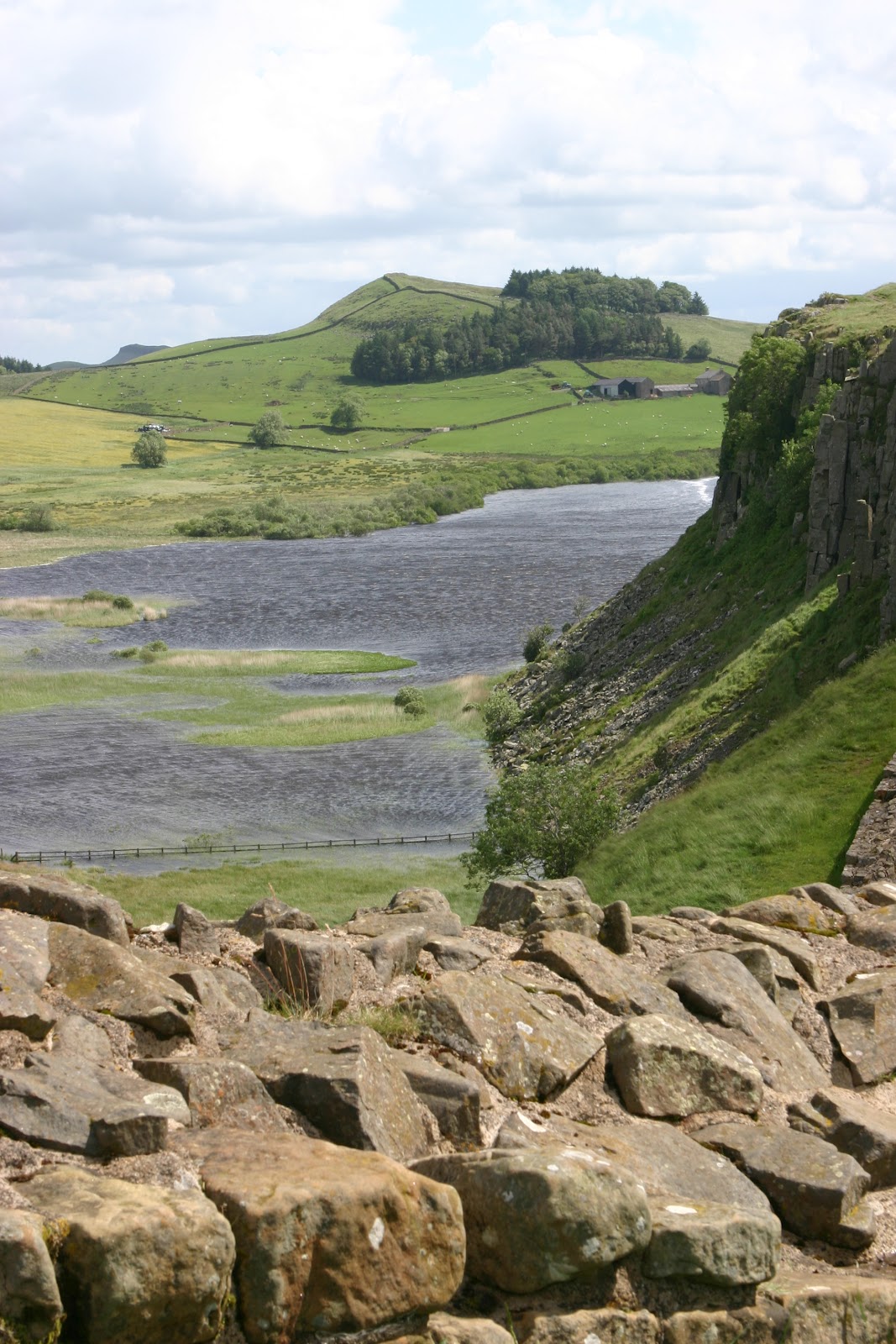
Somewhat by chance I ended up following the wall along the top
of - yes indeed - Whin Sill. I was rather boringly excited about this realising
that I was in a landscape that I had rote learnt about.
Finding that it actually existed, and there I was walking on it, was an experience; those walking with me suffered from my exuberance! The actual experience was so much better than just the photographic memory.
 The visit
to Whin Sill made me think about learning more generally. And how we ask our
students to learn in the context of libraries! What can we do to make the whole experience
come alive for them, to the point where they leave the classroom excited (yes -
why not?) and motivated? Have we ever been the participant in a session that is just like the ones we deliver ourselves and have we come away having had an 'experience' that we don't forget and where everything comes alive? Or, hand on heart, not....
The visit
to Whin Sill made me think about learning more generally. And how we ask our
students to learn in the context of libraries! What can we do to make the whole experience
come alive for them, to the point where they leave the classroom excited (yes -
why not?) and motivated? Have we ever been the participant in a session that is just like the ones we deliver ourselves and have we come away having had an 'experience' that we don't forget and where everything comes alive? Or, hand on heart, not....The 'experience' is really important, and in so many instances it will be one that makes an impact because it hits the spot - it's personal to that students, it's timely, it's relevant, it makes a difference. However, it should also be one that is backed up with an opportunity to reflect on how the experience has impacted and supported learning, and it is this that makes a difference. Beaty (2003) summarises the potential and value of this by saying: 'the challenge for modem higher education is not simply to train the next generation of academics, it is rather to tie learning from experience inextricably to academic study and vice versa in a strong lifelong process of learning which develops the person and society'.
 It strikes me that by ensuring that we consider both experience and reflection together we may be forced to re-examine what we do, how we do it, what impact it may have, and what the whole point of learning is. My rote learning of geographical features was semi-useful for an exam, but the subsequent experience will be far more memorable in the long run.
Beaty,'Supporting learning from Experience', In: H. Fry, S. Ketteridge, & S. Marshall (eds.) A Handbook for Teaching and Learning in Higher Education. London: Kogan Page
Monday, 30 April 2012
Cut to the quick
"To cut to the quick" literally means to trim (cut) a fingernail down to the nailbed, the living tissue that bleeds - the "quick" is the living flesh.
Today it was pointed out to me that Harvard is scrabbling around trying to rationalise its 73 libraries. On the one hand there was a slight sense of relief in me that it is not just the UK that is feeling the pinch in its academic libraries; on the other hand bemusement as I read about the process that they are undergoing. It was a bit of deja vu as, once again, communication skills seem in short supply, and it appears that the financial and administrative sectors of the university are of more importance in their considerations than their users or employees. I'm not overly convinced from what I have seen reported that the Harvard mangement know how to keep their employees on board.
I started wondering about what might happen in the forseeable future when Cambridge libraries have all been affiliated and denuded of experienced library staff - I am guessing in the name of sensible re-structuring and saving money for those all important e-journals. I wondered what might be the impact of this on the Quickstart for Part 1 dissertation session that Isla and I taught this afternoon.
1. I guess it couldn't possibly have been given using two members of staff (irrespective of the unique contribution each brought to the table)
2. I suppose it probably wouldn't have been worth doing as the room wasn't full and it might have been deemed a waste of time
3. A handout would have done - surely - after all they took away handouts summarising the key points (note I have been reading up about 'learning styles' and have understood that theorists and reflectors like stuff to take away with them...but on the other hand does doing away with a session like this help the activitists and pragmatists?)
4. Surely we could just pop an online tutorial up on CamTools and they could all do that?
5. The students would only have missed a vew vital things like the fact that MLA International Bibliography is very useful, that JSTOR is not the only store of online journals in the university, that managing your information, backing it up, making use of Zotero is sound advice, that Zetoc provided the life saver article for this week's essay, that they can now figure out when they have a journal title where to go to find print or online. Surely they could pick all this up somewhere else.......
6. No face-to-face interactions with us - this will probably mean that they wouldn't want to ask us, so they would just muddle by, ask their friends, their supervisor, their DoS, their Mum, Google. That'll be ok won't it?
So - in the future what would happen to our Quickstart sessions - well, bottom line is I suspect that we couldn't possibly have run the session above. Which, to my mind is more than just a case of 'what a shame'! The impact of the Quickstart session we ran today on these students will be measured and I can guarantee that I will prove that it had a positive impact on their academic development. I cannot guarantee anything of the sort in the bright, shiny new future we face.
When all the libraries similar to ours are reduced in size, amalgamated with other libraries, manned by a pool of people who know nothing about the subject, and can no longer help the students in similar ways to our Quickstart session, then the combined impact on student learning will be terrifying. I wonder if both Cambridge and Harvard are forgetting, to their cost, the impact that library facilities (resources and services) have on their worldwide research and teaching status.
Today it was pointed out to me that Harvard is scrabbling around trying to rationalise its 73 libraries. On the one hand there was a slight sense of relief in me that it is not just the UK that is feeling the pinch in its academic libraries; on the other hand bemusement as I read about the process that they are undergoing. It was a bit of deja vu as, once again, communication skills seem in short supply, and it appears that the financial and administrative sectors of the university are of more importance in their considerations than their users or employees. I'm not overly convinced from what I have seen reported that the Harvard mangement know how to keep their employees on board.
I started wondering about what might happen in the forseeable future when Cambridge libraries have all been affiliated and denuded of experienced library staff - I am guessing in the name of sensible re-structuring and saving money for those all important e-journals. I wondered what might be the impact of this on the Quickstart for Part 1 dissertation session that Isla and I taught this afternoon.
1. I guess it couldn't possibly have been given using two members of staff (irrespective of the unique contribution each brought to the table)
2. I suppose it probably wouldn't have been worth doing as the room wasn't full and it might have been deemed a waste of time
3. A handout would have done - surely - after all they took away handouts summarising the key points (note I have been reading up about 'learning styles' and have understood that theorists and reflectors like stuff to take away with them...but on the other hand does doing away with a session like this help the activitists and pragmatists?)
4. Surely we could just pop an online tutorial up on CamTools and they could all do that?
5. The students would only have missed a vew vital things like the fact that MLA International Bibliography is very useful, that JSTOR is not the only store of online journals in the university, that managing your information, backing it up, making use of Zotero is sound advice, that Zetoc provided the life saver article for this week's essay, that they can now figure out when they have a journal title where to go to find print or online. Surely they could pick all this up somewhere else.......
6. No face-to-face interactions with us - this will probably mean that they wouldn't want to ask us, so they would just muddle by, ask their friends, their supervisor, their DoS, their Mum, Google. That'll be ok won't it?
So - in the future what would happen to our Quickstart sessions - well, bottom line is I suspect that we couldn't possibly have run the session above. Which, to my mind is more than just a case of 'what a shame'! The impact of the Quickstart session we ran today on these students will be measured and I can guarantee that I will prove that it had a positive impact on their academic development. I cannot guarantee anything of the sort in the bright, shiny new future we face.
When all the libraries similar to ours are reduced in size, amalgamated with other libraries, manned by a pool of people who know nothing about the subject, and can no longer help the students in similar ways to our Quickstart session, then the combined impact on student learning will be terrifying. I wonder if both Cambridge and Harvard are forgetting, to their cost, the impact that library facilities (resources and services) have on their worldwide research and teaching status.
Friday, 20 April 2012
Impact - 'In God we trust - all others must bring data' (Megan Oakleaf, LILAC keynote)
Just when I have been chewing my finger nails down to the quick about how to prove how much impact our library service has, two rather startling (even impactful) things occurred.And one further related coincidence. I could say that it was all down to the excellent presentations at the recent LILAC conference , but it wasn't quite.


Impact 1. I was attracted to a blog post - and a related article on understanding what impact we have on learning which really made enormous sense to me. The gist of the article said that if we are trying to prove how impactful we are in libraries that one way of doing this is to consider the academic pinnacle of student achievement and consider whether the library, as resource and service, have had an impact on student learning goals. For me this means - forget information literacy, forget all the goals that WE make up and WE think the students need to know. Look instead at the actual learning aims and outcomes that our Faculty sets the students and find out from the students whether we have had any effect on them achieving those learning goals (that's what we're here for - right?).
 Impact 2. I heard an excellent keynote at LILAC by Megan Oakleaf. (http://meganoakleaf.info/default.asp). In many ways what was said was not revolutionary but the way it was presented created a wake-up-call 'oh I get it' type of reaction in me. Essentially it chimed with the article I had just read (above). She said - quite forcibly - look at what the institutional goals are for our students and work out whether the library service is having any impact on those goals (again this to me says it is not OUR goals, or information literacy goals, but our institution's goals that matter - which is a really important distinction).
 As put in her IFLA paper 2010:
"Value is defined in terms of institutional, not library, goals. The purpose of this research is to help academic libraries demonstrate their value to the institutions in which they are embedded. Libraries need to identify institutional goals (e.g., increasing student retention and graduation rates; increasing student achievement; increasing faculty research output) in order to communicate value in terms that institutional administrators will appreciate." [Full article available here http://www.ifla.org/files/hq/papers/ifla76/72-hinchliffe-en.pdf]
Megan had two tangible ways of visualising all this - firstly a Library impact map, (http://meganoakleaf.info/libraryimpactmap.pdf) and secondly a grid which I'll be using in staff meetings for working out whether we have sufficient evidence to support our beliefs that we support institutional goals. My regular harping on institutional mission seems a valid 'harping'. By providing the institution with evidence of our impact on THEIR goals we are demonstrating our importance and usefulness.

Coincidence no. 1. and impact 3. A book on quality of student learning in HE that I was dipping into had a word in the index that I would not have noticed, apart from the fact that it was mentioned in the article referred to in the blog post above. The authors talked of a student's 'capstone' experience which in my Faculty means the dissertation. It seemed a peculiar, though rather exciting coincidence.
 So what? Well, I am shocked that I have not done this before, but I have finally have in post-it notes all around my desk reminders of what it is that the Faculty expect our students to have achieved in writing a dissertation (it's not that what we want them to learn is unimportant, it's just not the best way to go about proving our worth!!). Now I have this, I can explore ways of gathering evidence to prove that the Library service contributes and has an impact (ie without us they would not progress as they are expected to do so) on student learning. Starting from this perspective means that when the service comes under threat I have clear evidence that says without us student learning (Faculty goals) will be impacted negatively.

Monday, 12 March 2012
iBARD
 Working this vac on Shakespeare? Have a look at some of the specific resources the Faculty Library provides to help you:
*****
The Faculty Library's subject guide is available online or in print in the Library and includes many print and electronic resources
*****
The Renaissance subject guide provides broader resource choices for the period
*****
DVDs of Shakespeare plays including several copies of the BBC Shakespeare series are available on the first floor of the Library
*****
Useful ebooks for the Renaissance period - includes Shakespeare secondary crit.
Make sure that you hav
 e selected Style B in LibraryThing to view the comments field and the link to the ebooks.
Examples of ebooks available:
Shakespeare, Theory and Performance
Shakespeare’s political drama: the history plays and the Roman plays
Shakespeare's Festive Tragedy: The Ritual Foundations of Genre
Roman Shakespeare: Warriors, Wounds and Women (Feminist Readings of Shakespeare)
How To Do Things With Shakespeare: New Approaches, New Essays
Companion to Shakespeare's works: Volume I - IV
*****
Digital Theatre have a number of Shakespeare productions available to view including Much Ado about Nothing with David Tennant and Catharine Tate. Login details available via Part 1 Paper 5 resources on the Library's CamTools site.
*****
World Shakespeare Bibliography Online - subscribed for you to use on behalf of the Faculty Library.
*****
Tuesday, 6 March 2012
Lego, online resources, people and creativity
 What do online-only discussions, Lego, e-resources, processes and reading lists have in common? On the face of it very little. Practically speaking these were the core elements of my last week, and it was curious how in the end they all informed each other.
Here's the Lego model which represents yours truly created (by myself and one other member of staff) as part of a lego workshop run by Andy Priestner for the EFL staff. Although this happened at the beginning of the week, it was a rather uncanny summary of the week to come. Incidentally EFL staff are still talking, a week on, about the workshop, and loving our little Lego presents from Andy!
Some of the key issues of the week:
1. Concerns over proposing e-only resources cannot be disregarded. Arguably concerns about reduced budgets mean we might need to go for what appears to be the cheaper option ie online, ( although please don't forget the 20%VAT!) but once we put the user into the equation, the whole thing gets turned on its head as we must realise that the cost to the library will likely be a loss of customers? Why? Becasue libraries are consistently failing to provide e-only at the speed that users expect. They will go to Google because Google satsifies their need for quick and easy access. They like print, but if it no longer exists for them in a library they will go to where they can get it quickly and cheaply ie Amazon, and if they want to use e-books they will use their Christmas present Kindles and download whatever they can get quickly and ideally for free from Amazon.

Students are file sharing, which we may know is illegal, but users do what they can to get hold of what they want quickly and effectively. The cost to the library also increases if e-only is put in its proper context where discovery tools and related strategies and procedures must be in place to maintain ease of access to online. I don't see how e-only can be cheaper.
2. Understanding our own skills and that of our colleagues is essential for the processes and procedures that we have in place to work. The best procedure on paper will not always work in practice if staff do not play ball. Communication is of paramount importance. I have started to work on the assumption that I have never done quite enough in this area. When I have become complacent (and/or too busy), things fall apart.
3. Always always always put the user into the equation and work out what they want. A reading list that an academic has sweated over is useless if no one uses it. A database recommended by an individual Phd student or academic cannot possibly be purchased on the basis of that one recommendation. The user population at large should be consulted
 . Changes in management structures, whether driven primarily by finance issues or not, must have the user's needs at the heart. Senior management may claim to know what user's needs are. I sometimes wonder what the basis is for this assertion? I would challenge them to go and talk to their users and find out what they think and what they are doing. I like to think that I put users first, but there have been too many times when I have failed to consult before acting. I am learning the lesson that when I remember to talk to them, then services that emerge are targeted, personalised and much appreciated.
4. Finally summary point for the whole week - building in time for creativity is absolutely mind-blowingly essential for our roles in library services.
Sunday, 12 February 2012
Personalising services: snippets from the diary

Co-editor, Andy Priestner, and I very recently deliberated a tweak to the name of our forthcoming book to be published by Ashgate. The original title referred to personalised services but almost without realising it, Andy had started to use the word 'personalising' instead. This gives the process and concept a more active, and engaging feel to it. It made me think a little harder about what helps us to create a service that is 'personalised', but is also 'personalising'; where the established mindset of providing a 'personalised' service sits within a dynamic 'personalising' environment.
The 'personalised' mindset in a library service means that we should be pre-disposed to acquire knowledge about our users, show a genuine interest in them, display empathy, and be flexible and adaptable, with library staff possessing a fair degree of autonomy in the decision making process.
 But I think that 'personalising' a service means more than this. It implies that in any given situation an individual student or library user should leave feeling that their visit was special (not just to them, but also to us) and that their specific needs and requirements have been addressed. Is this possible? I think that this is precisely why personalising services is an active, growing, organic 'thing'. Your first interaction with a student in a new job is likely to be less 'personalised' than one six months later. We are always gathering information and knowledge (or should be) about our users that we can use in our interactions with them. Just because all students have the same borrowing time frame doesn't prevent us personalising our service on a daily basis with them depending on our knowledge of their needs.
Two really obvious snippets from my diary:
1. I know that a particular elderly academic rarely reads email and so will not receive their system notice reminding them the book is due back. I pop the details in my diary and get in touch with them personally by phone to remind them it's due back and/or personally renew it for them. I would be unlikely to do this for the same reason for an undergraduate but that's because their needs are different. (Question for myself: what current procedures and process can we change so that we operate more like this?)
2. I have a new resource coming out on trial. It may well be useful for a broad spectrum of people, but I know that there are two postgrads who specifically requested it some months ago. Their emails will be included in the general email list that they are a part of, but they also get a personal email from me letting them know about it. Their names went down in my diary some months ago for this purpose. (Question for myself: although I use my personal email address rather than any generic ones to send information out, many emails still go to student 'lists'. If email is still the preferred means of receiving information, the challenge is to become more personalised and targeted.)

I'm sure that we all do this sort of thing but the challenge for me is to consider how much more we can do? And how much more can we afford to do? Conversely, how much more can we afford NOT to do!
Not everyone wants the red carpet treatment - but it's our job to know who doesn't and to treat our users as individuals.
Subscribe to:
Posts (Atom)